

The Workload Nobody Sees in Helping Professionals
There’s a particular kind of exhaustion that many helping professionals carry quietly.
It’s not always visible in appointment numbers, productivity targets, or calendar load. In fact, some clinicians and care workers appear highly capable on the outside — functioning, responsive, dependable — while internally operating in a near-constant state of emotional and cognitive strain.
For psychologists, allied health clinicians, NDIS staff, aged care workers, and other helping professionals, burnout is rarely just about “working too much.”
More often, it reflects the cumulative impact of carrying responsibility that is emotional, ethical, relational, and psychological — often without adequate recovery, containment, or systemic support.
The Invisible Labour of Caring Work
Helping professions involve a type of labour that is difficult to quantify.
Beyond the visible tasks — documentation, appointments, case notes, reports, meetings — there is the invisible workload of:
- holding distress and trauma stories
- regulating your own emotional responses in real time
- monitoring risk and safety
- making ethically complex decisions
- maintaining therapeutic presence while under pressure
- absorbing conflict, grief, anger, or urgency from others
- managing uncertainty and responsibility
This ongoing emotional and cognitive load requires significant nervous system energy.
Many professionals are not simply “doing tasks.” They are continually processing human suffering while attempting to remain calm, empathic, clinically sound, and professionally accountable.
Over time, this can create a chronic state of internal activation — particularly when there is insufficient space for recovery or reflection.
Burnout and Compassion Fatigue Are Not the Same Thing
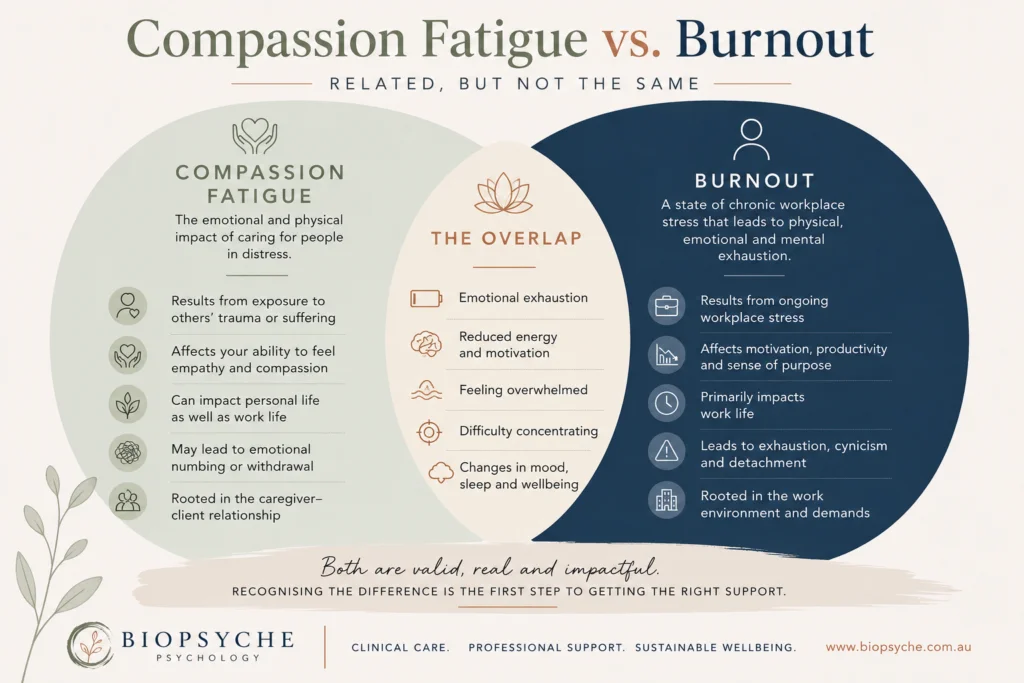
These terms are often used interchangeably, but clinically they describe different experiences.
Burnout is typically associated with prolonged workplace stress, excessive demand, reduced autonomy, and insufficient recovery. It often presents as exhaustion, cynicism, emotional depletion, reduced efficacy, and detachment.
Compassion fatigue, on the other hand, relates more specifically to the cumulative emotional impact of exposure to others’ suffering and trauma. It can involve emotional numbing, reduced empathic capacity, heightened irritability, or a sense of emotional overwhelm.
Many helping professionals experience elements of both simultaneously.
What complicates this further is that clinicians are often expected to continue functioning at a high level regardless of their internal state.
The pressure to remain composed, available, and unaffected can become part of the problem itself.
The Pressure to Appear Fine
One of the less discussed aspects of clinician burnout is the professional culture around coping.
Many helping professionals are highly conscientious people. They are used to being the stable one, the reliable one, the person others turn to in distress.
As a result, professionals may minimise their own stress until their nervous system is already significantly overloaded.
Common internal narratives include:
- “Other people have it worse.”
- “I should be able to manage this.”
- “I can’t fall apart when clients rely on me.”
- “If I reduce my workload, I’m letting people down.”
In healthcare, disability, education, and mental health systems, there can also be an unspoken expectation that competence means emotional endurance.
But appearing functional is not the same thing as being well.
Moral Distress and Systems Pressure
Many clinicians are not only exhausted by client work — they are distressed by the systems they are working within.
Moral distress occurs when professionals know what would best support a client or patient, but are constrained by systemic limitations such as:
- inadequate funding
- excessive caseloads
- workforce shortages
- administrative burden
- restrictive policies
- risk-focused systems
- unrealistic KPIs
- insufficient service availability
Over time, repeatedly working in ways that conflict with professional values can create emotional exhaustion, helplessness, frustration, and disengagement.
This is particularly common in sectors where demand consistently exceeds capacity.
Helping professionals are often trying to provide deeply human care inside systems that prioritise throughput, compliance, and efficiency.
That tension carries a psychological cost.
Fear of Complaints, Errors, and “Getting It Wrong”
Another invisible pressure in helping professions is the constant awareness of responsibility.
Many clinicians carry ongoing anxiety about:
- making mistakes
- missing risk indicators
- documentation standards
- complaints processes
- professional scrutiny
- adverse outcomes
Even highly experienced professionals may operate with a persistent background vigilance that never fully switches off.
For trauma-informed and empathic practitioners, this pressure can become amplified by a strong sense of duty toward clients and outcomes.
The result is often chronic hyper-responsibility — where the nervous system remains in a prolonged state of monitoring, anticipating, and carrying.
Why Supervision Matters More Than Many Realise
Good supervision is not simply administrative oversight or case discussion.
At its best, supervision provides:
- clinical reflection
- emotional containment
- ethical support
- perspective
- professional grounding
- nervous system regulation through relational safety
Helping professionals regularly witness distress, trauma, conflict, grief, and human complexity. Without spaces to process these experiences safely, the emotional residue accumulates.
Supervision can help clinicians:
- reduce isolation
- maintain reflective practice
- recognise early signs of burnout
- navigate ethical complexity
- reconnect with professional values
- sustain long-term practice capacity
Importantly, supervision should not only occur when someone is already overwhelmed.
Preventative support matters.
Burnout Is Not a Personal Failure
One of the most harmful misconceptions around burnout is the idea that it reflects weakness, poor resilience, or inadequate self-care.
In reality, many burnt out professionals are highly capable, deeply conscientious, and profoundly committed to the people they support.
Often, they have simply been carrying too much for too long without sufficient recovery, support, or systemic protection.
No nervous system is designed for continuous output without restoration.
Supporting the People Who Support Others
Helping professionals deserve support that recognises the complexity of the work they do — not just practically, but psychologically and emotionally.
If this article names something you are carrying, there are three ways to work with me: psychological therapy, psychology supervision and professional consultation for psychologists, or professional consultation and reflective practice for helping professionals in demanding roles.
Sometimes the most important support is having a space where you no longer need to appear unaffected.
About Suzanne