

Psychosocial Hazards at Work: When It’s Not Just “A Busy Week”
Most people can recognise when work is physically unsafe.
A slippery floor. Faulty equipment. Something clearly not right.
Psychological safety is different.
It’s often quieter, slower, and much easier to explain away.
You might tell yourself:
- “It’s just a busy period.”
- “Everyone else seems fine.”
- “I just need to get on top of things.”
But over time, something starts to shift.
You feel more tired than usual.
More on edge.
Less like yourself at work.
This is often where psychosocial hazards begin to show up.
So what are psychosocial hazards—really?
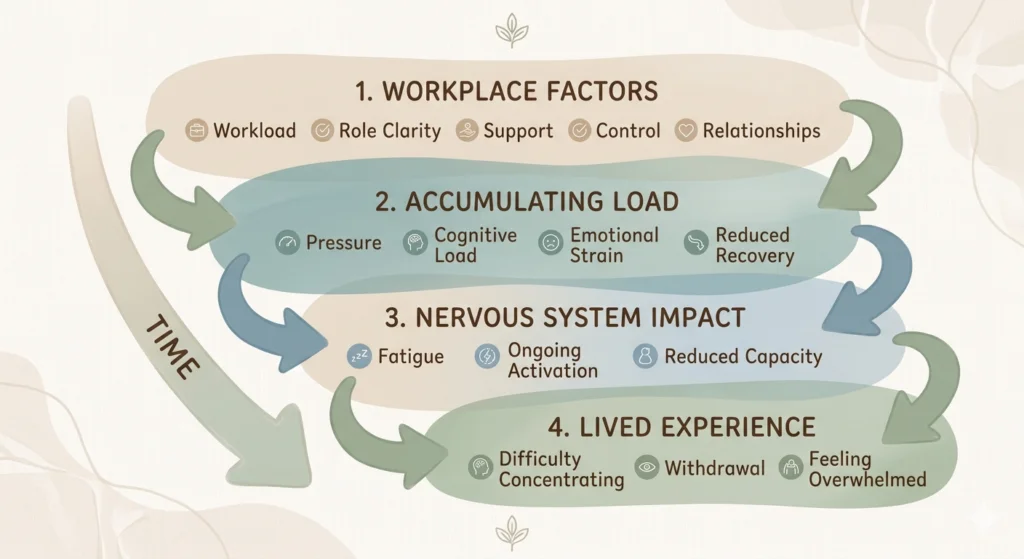
Psychosocial hazards are not one-off events.
They are patterns in how work feels over time.
They sit in things like:
- how much is expected of you
- how clear your role is
- how you’re treated by others
- how much control or support you have
As outlined in our client resource , these factors are often built into the structure of the workplace itself—not just the individual experience.
Which is why two people can be in the same role, and one is coping… while the other is slowly burning out.
What this can actually look like day-to-day
Psychosocial hazards don’t usually announce themselves clearly.
They tend to show up in ways that feel familiar, even normal.
The workload that never really lets up
You finish one task and three more appear.
There’s no clear “off” point. Even when you’re home, your mind is still at work.
The role that keeps shifting
Expectations change. Priorities move.
You’re not quite sure what “good enough” looks like anymore.
The constant low-level tension
Communication feels strained.
There might not be open conflict—but things don’t feel settled either.
Feeling like you have no real say
Decisions are made around you, not with you.
You’re expected to adapt, often without input or warning.
The effort that goes unnoticed
You’re putting in a lot—but it doesn’t seem to land.
There’s little feedback, or it doesn’t reflect the reality of what you’re managing.
The environments that take a toll
For some roles, it’s exposure to distress, conflict, or unpredictability.
For others, it’s pressure, isolation, or constant urgency.
Individually, these might seem manageable.
Together, over time, they’re not.
Why it builds the way it does
Your nervous system is designed to adapt.
So when work becomes demanding, you don’t immediately “burn out.”
You adjust.
You push a bit harder.
You stay switched on longer.
You override the early signs of fatigue.
For a while, this works.
Until it doesn’t.
What often follows is not a sudden collapse—but a gradual shift:
- things feel harder than they used to
- your capacity feels reduced
- small tasks take more effort
- you start withdrawing, even if you don’t mean to
This isn’t a lack of resilience.
It’s what happens when demand consistently outweighs recovery.
Why people often don’t recognise it
There are a few common reasons this goes unnoticed:
- It’s normalised
“That’s just how this job is.” - It’s gradual
There’s no clear moment where things changed. - It’s internalised
People tend to ask: “What’s wrong with me?” rather than “What’s happening around me?” - High performers compensate
Until the system they’re relying on starts to strain.
The important shift
Understanding psychosocial hazards often changes the question from:
“Why can’t I handle this?”
to
“What about this environment is asking too much, for too long?”
That shift matters.
Because these are not just individual problems.
They are workplace health and safety issues.
Where responsibility sits
In Australia, psychosocial hazards are recognised under WHS law.
Which means organisations have a responsibility to:
- identify these risks
- reduce or manage them where possible
- consult with employees
- create safer, more sustainable systems of work
This doesn’t remove personal agency—but it does place the responsibility where it belongs: not solely on the individual.
What can actually help
There’s no single fix—but there are starting points.
Often, it begins with clarity.
- Noticing what specifically is draining or unsustainable
- Putting language to the patterns (not just the feeling)
- Tracking when things spike or ease
From there, support becomes important:
- talking it through with someone who can help you make sense of it
- exploring workplace options where appropriate
- rebuilding some capacity for rest and recovery—not just time off, but actual recovery
And in some cases, it involves broader change—how the role is structured, how support is provided, or how expectations are set.
A steady, realistic perspective
Psychosocial hazards are part of many workplaces.
But ongoing exposure is not something people are meant to absorb indefinitely.
When the environment shifts—or when the right supports are put in place—people often regain clarity, energy, and a stronger sense of control over their work and wellbeing.
This article is for general psychoeducation and is not a substitute for individual clinical advice. If you’re noticing ongoing changes in your wellbeing, it may be helpful to speak with a qualified health professional.
Read more about workplace psychological harm — what it is, and how psychological support can help.
About Suzanne